

Introduction to Python
Certificate Course - Financial Engineering - FE.1.4.I26
| Date | Nov 18 - 20 and 24 - 25, 2026 |
| Duration | 4.5 days |
| Location | On campus - Karlsruhe |
| Language | English |
| ECTS | Upon request |
| Cost | 2,500 € |
Fundamentals
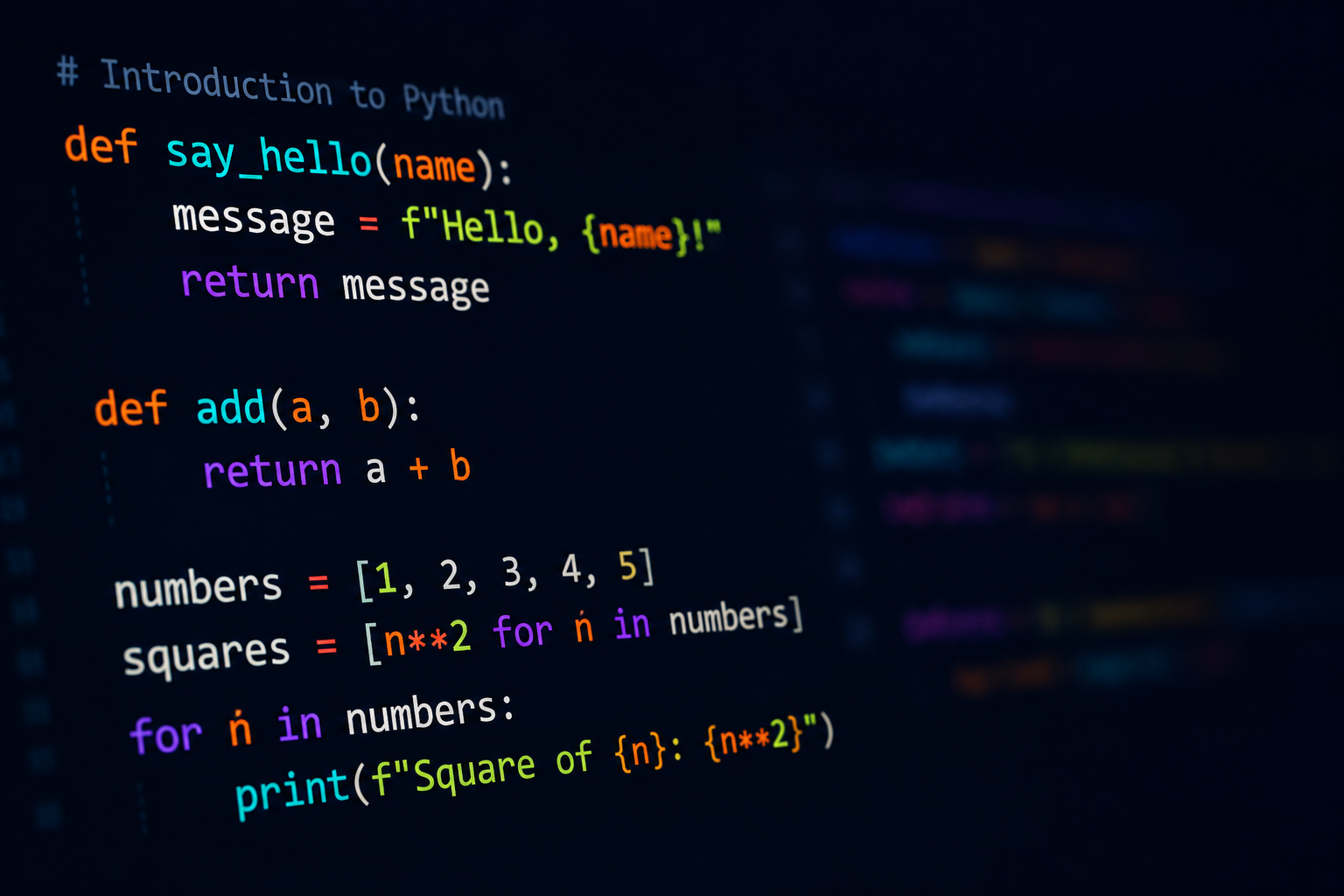
Learn Python basics, including syntax, variables, functions, and objects, building a strong foundation in programming concepts.
Technology
Develop practical coding skills in Python, creating routines and working with data from sources such as Excel files and webpages.
Applications
Apply Python to real tasks in data handling and analysis, using its flexibility for problems in statistics and computer science.
What You´ll explore
- Explore the fundamentals of Python programming, including syntax, variables, functions, and objects.
- Understand how to structure code and build reusable routines for efficient problem solving.
- Learn how to read and process data from external sources such as Excel files and webpages.
- Discover how Python is used in statistics and computer science for data analysis and automation.
Your Key Takeaways
-
Understanding of core Python programming concepts and syntax
-
Ability to declare variables, functions, and objects in Python
-
Skills to write structured and reusable code
-
Knowledge of how to import and handle data from Excel and web sources
-
Practical experience in applying Python to data-related tasks
-
Foundation for further study in data analysis, statistics, and software development
Taught by Recognized Experts in Introduction to Python
Benefit from the knowledge of leading specialists with extensive experience in research and industry. Their deep expertise guarantees a course of outstanding academic and practical quality.
Prof. Dr. Maxim Ulrich

Prof. Dr. Maxim Ulrich is Professor of Risk Management and Financial Economics at KIT and has built an international academic career, including serving as Tenure-Track Assistant Professor at Columbia Business School from 2008. His work focuses on quantitative finance, asset pricing, and financial machine learning, making him a recognized expert in the field.
He brings extensive experience from academia and practice, including fintech ventures and collaborations with institutions such as the ECB and Eurex.
Who Should Attend
This course is particularly beneficial for professionals in the following fields:
-
Data analysts and business intelligence specialists
Professionals working with data visualization, reporting, or business analytics who want to automate processes and deepen analyses using Python. -
Software developers and engineers
Engineers, developers, or IT professionals transitioning into Python-based programming for application development, automation, or scripting. -
Researchers and academics in science and engineering
Researchers, PhD candidates, or academics aiming to enhance data processing, simulation, or computational tasks with Python. -
IT and data professionals in finance, healthcare, or engineering
Specialists in domains like finance, healthcare, or industrial automation using Python for data-driven solutions and workflow optimization. -
Project managers and decision-makers in tech-driven organizations
Leaders overseeing digitalization, software projects, or data initiatives who need a practical understanding of Python’s capabilities. -
Beginners with basic technical affinity
Professionals with little to no programming experience but eagerness to learn Python for career advancement in data or software fields.