

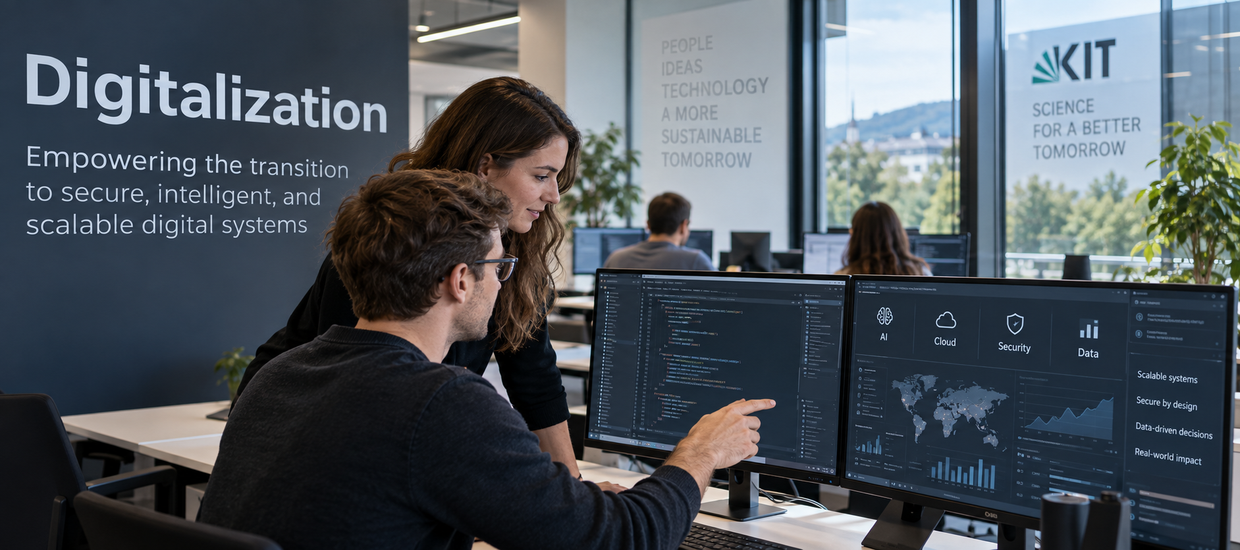
Digitalization
Empowering the transition to secure, intelligent, and scalable digital systems

Lead the Next Wave of Software-Driven Transformation
Digitalization is reshaping every industry, enabled by advances in software engineering, AI, cloud computing, and cybersecurity. Information Systems Engineering today is not just about building software. It’s about designing robust, data-driven systems that create value, enable new business models, and protect critical infrastructure.
At HECTOR School, we combine KIT’s cutting-edge research with industry-relevant education to prepare professionals for the challenges and opportunities at the intersection of technology, data, and security.
What Is Transforming Digitalization?
Technology, regulation, and market expectations are accelerating the shift to software-defined enterprises.
Core drivers of change:
- AI, Data, and Automation: Breakthroughs in ML and Physical AI enable intelligent products, services, and operations
- Cloud and Digital Platforms: Cloud-native architectures and platform ecosystems make scalable, composable services the norm
- Cybersecurity and Privacy: Rising threats and stricter regulations demand secure-by-design systems and privacy-first architectures
- Data Governance and Law: Data residency, AI regulation, and compliance frameworks shape how data is used and monetized
- Critical Infrastructure and Blockchain: Decentralized systems, smart contracts, and resilient architectures enable trusted transactions
The Challenges Leaders Need to Solve
Digital leaders must bridge software engineering, AI, and governance to deliver secure, scalable solutions.
Core challenges:
- From Prototype to Production: Building resilient, cloud-native systems with CI/CD, DevOps, and MLOps
- Security by Design: Embedding security, privacy, and compliance into architectures and development lifecycles
- Data and AI at Scale: Operationalizing models, ensuring explainability, and governing data responsibly
- Platform Strategy: Defining APIs, ecosystems, and monetization to realize network effects without lock-in
- Talent and Culture: Building skills in software, cloud, AI, and governance while driving transformation at pace
Digitalization Expertise at KIT
Karlsruhe Institute of Technology (KIT) unites computer science, engineering, and management to shape the future of digital systems.
Areas of KIT research excellence:
- Software and Cloud Engineering: Cloud-native architectures, microservices, and platform engineering
- Artificial Intelligence and Physical AI: Intelligent perception, decision-making, and AI-as-a-Service (AIaaS)
- Cybersecurity and Privacy: Secure systems, cryptography, and privacy-preserving technologies
- Data and AI Governance: Responsible AI, data law, and compliant data management
- Distributed Systems and Blockchain: Trusted platforms, smart contracts, and resilient infrastructure
KIT infrastructure:
- Access to supercomputing and AI infrastructure at the Scientific Computing Center (SCC)
- Collaboration with tech leaders and critical-infrastructure partners
- Participation in EU and national AI/data initiatives
- Access to industry-grade DevOps, MLOps, and security toolchains
Learn from the Experts
Behind digitalization research and education at HECTOR School are leading KIT academics and industry practitioners who bring real-world challenges into the classroom.
 |
Prof. Dr. Andreas Oberweis, Institute of Applied Informatics & Formal Description Methods (AIFB) at KIT
Program Director Information Systems Engineering and Management
Research areas:
Roles/Experience: |
 |
Prof. Dr. Ralf Reussner, Head of Institute of Dependability of Software-intensive Systems (DSIS) at KIT
Program Director Information Systems Engineering and Management
Research areas:
Roles/Experience:
Get to know Prof. Reussner in his interview. |



From Research to the Classroom
What you learn at HECTOR School is not just textbook knowledge. It's directly derived from KIT research and applied to real digital transformation projects.
- Research-Driven Curriculum: Courses integrate the latest in AI, cloud, cybersecurity, and software quality
- Industry-Relevant Projects: Case studies in platform strategy, critical infrastructure, and AI productization
- Hands-On Tooling: Python-first AI, cloud-native stacks, CI/CD, IaC, and security frameworks
- From Knowledge to Impact: Graduates apply what they learn immediately in thier professional roles
Build Your Expertise in Digitalization
Whether you’re a software engineer, data scientist, or digital product leader — HECTOR School offers tailored paths to accelerate your impact:
Part-time M.Sc. programs combining software engineering, AI, security, and management.
M.Sc. Information Systems Engineering and ManagementShort, intensive courses on specific digitalization topics, ideal for focused upskilling or continuing education.
Digitalization Certificate CoursesTailor-made training solutions for companies — from small-team programs to full corporate academies.
Corporate Programs