

Power Supplies that Last Three Times Longer
From smartphone chargers to high-performance lasers, from blenders to industrial washing machiens, and from laptop power adapters to charging stations for electric vehicles - switched-mode power supplies are ubiquitous in powering electrical devices of all sizes and power levels. They convert the alternating current (AC) from the power grid into the direct current (DC) required by the device. The problem: power supplies are prone to failure, particularly when subjected to heavy loads. As a result, the service life consumer devices can be significantly shortened, while in industrial applications, more frequent maintenance is at least required. Scientists at KIT have now developed innovative intelligent power supplies that are significantly more durable.
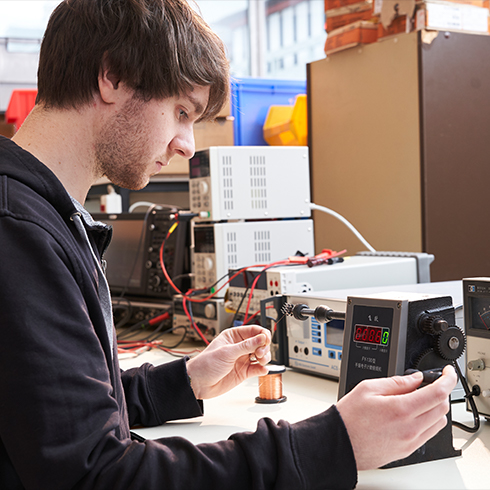 The switched-mode power supplies commonly used today are lightweight and compact, but the electrolytic capacitors they contain also make them prone to failure. Film capacitors, ba contrast, have a significantly longer service life. Howver, they can require up to ten tomes as much space. "We have developed a digital control method that makes it possible to use film capacitors while requiring only slightly more space," says Michael Heidinger from KIT's Light Technology Institute (LTI). "Our control method runs on a microcontroller integrated into the power supply. It detects disruptive environmental influences, allowing fluctuations in the input voltage, for example, to be compensated for", Heidinger explains. This means that energy-storage capacitors with a lower capaciture are sufficient. "Using these film capacitors eliminates the main cause of power supply failures: electrolytic capacitors. Depending on the design, this can even triple the operating lifetime of the end device," adds scientist and colleague Qihao Xia.
The significantly longer service life is far from the only advantage of the new power supplies. Another is their considerably lower maintenance requirements: "This is a major advantage, especially in applications where maximum reliability is essential, such as aviation, electric vehicles, or industrial applications," says Heidinger. Another key benefit is the power supplies' high degree of adaptability. "We can easily implement specific customer requirements, such as enhanced fire protection or dynamic output voltage ajustments," Heidinger explains. For example, if a power supply limits its maximum output power, less stringent fire protection requirements may apply in sensitive buildings such as airports.
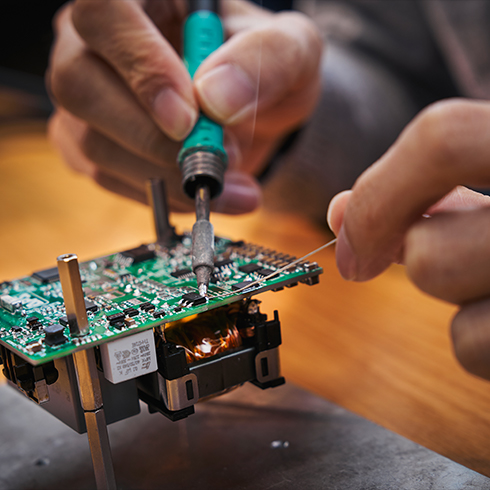 According to Heidinger and Xia, the first customers are therefore likely to come from industries where a flexible output voltage is required. The scientists are also focusing primarily on industrial applications such as production lines, where users expect equipment to have a service life of 20 years. "When priduction facilities are down, costs can quickly add up."
The scientist expert limited interest from private consumers, however. "Very few people have had their smartphone chargers fail so far," Heidinger acknowledges. This is because such chargers are typically compared to the technological leap from analog to digital photography." Power supplies can now be monitored and maintained remotely, integrated into the Internet of Things, and used as data sources for visualization or deep learning applications.