

M.Sc. Energy Engineering and Management
Future Energy Systems and Technologies

Power a Greener Future. Manage Complex Energy Networks.
"The implementation of a sustainable energy system requires connected methods and models that provide companies, politics and society with the necessary basis for making scientifically sound decisions on the design of the energy system transformation. „Energy Engineering and Management“ enables the students to play an active role in this transition process"
Program Director Prof. Dr.-Ing. Marc Hiller

Temir Vinokhodov (he/him)
Admissions & Program Consultant
info ∂does-not-exist.hectorschool kit edu
+49 721 608 47880
Key Facts
-
Structure: Part-time (but enrolled as a fulltime student)
- Duration: 15 months plus time needed for master's thesis (9 months)
- Module abroad in Barcelona, Spain: one of the management modules is held at the prestigious ESADE Business School in Barcelona/ Spain.
- Costs: 36,000.00 € (thirty-six thousand Euro) overall (detailed information on our tuition and financing webpage)
- Language: English
- Degree: Master of Science (M.Sc.) of the Karlsruhe Institute of Technology (KIT), 90 ECTS
- Start: Every year in October (flexible schedule possible)
- Application deadline: There is none. We have a rolling application process.
- Admission requirements: First academic degree (e.g. Bachelor, Master or Diploma), at least 2 years professional experience, English language proficiency. Find more here.
- Accreditation: by aaq
The energy transition is associated with many challenges, such as an increase in the efficiency of energy conversion systems based on renewable energies and their integration into future energy systems, requiring e.g. the development of capable energy storage systems and an intelligent demand side management. Our Master´s program in Energy Engineering and Management provides a comprehensive understanding of present and future energy systems, and the complex interactions of their elements. Graduates are able to analyze and optimize the energy systems' operating efficiency, availability, and safety.
Focus Points
- Power Generation (Solar, Thermal, Wind, Biomass, Gas, Coal)
- Energy Storage (Batteries, Thermal, Hydrogen, Fuel)
- Smart Grids & Buildings
- Power-to-X & X-to-Power
Activate the Progress of Intelligent Energy Systems and Energy Transition
The master's program Energy Engineering and Management is divided into 5 engineering and 5 management modules of 2 weeks each, over a period of 15 months. The modules are followed by a master thesis written in the company (9 months) and often used as an innovation project for the company. The overall duration is approx. 24 months.
| Engineering Modules | Management Modules |
|---|---|
"Selected Topics of Electrical Engineering" |
|
KIT's core competencies in the energy sector cover the entire energy chain from (renewable) energy generation, conversion, and distribution to social integration. In view of the constantly changing regulations on the international energy markets, the Master's program with its selection of engineering modules from KIT's teaching offers a unique holistic and international approach to the further education of (junior) executives in this sector.
 Download the program catalogue
International Cooperation
HECTOR School maintains fruitful cooperations with various academic partners worldwide. In the Master’s program Energy Engineering and Management, one of the Management modules is held in Barcelona at the ESADE Business School.

The concurrently taught Executive Master’s program is designed for working professionals. Block lectures scheduled at intervals allow participants to continue their demanding careers while acquiring new skills.
5 Management modules present broader knowledge in management know-how, including two modules conveying the universal topic of digitalization and the associated disruptive innovations. The 5 Engineering modules provide deeper knowledge in technological topics.
Order now our "Content Overview and Learning Targets" (COLT) to get a better understanding of your favored Master Program. You will get an overview over
- Study objectives (e.g. professional qualification for certain activities, scientific practice, knowledge of methods)
- Structure of the program
- Content and definition of courses (sub-areas, focal points)
- Study plan
Click here to request your "Content Overview and Learning Targets" handbook.
Participants of Energy Engineering and Management
High Potentials working as project managers, or engineering executives in the branches of energy generation, transportation, distribution, storage or sales, e.g. in:
- Utility companies
- Energy suppliers
- Manufacturers of power generation
Career Perspectives after Graduation
To master the manifold challenges of an energy revolution there is a need of highly qualified professionals who are willing to shape the future of energy supply.
Alumna Voice
„The program covers various areas (...), not only energy sources and supply, but also the economics aspects. The interesting fact about the course is that the lecturers are from both the university and industry. Hence, not only do I gain the theoretical background but also some insights of the real industry, which include a couple of excursions to running power plants.“
Siti Nurhafizah Haji Tengah, HECTOR School Graduate EEM, HAD Technologies
Find more Alumni Voices of our Master´s Programs
Download here the statutes for admission (German PDF) to the Master's program in Energy Engineering and Management.
Program Directors
 |
Prof. Dr.-Ing. Marc Hiller
|
 |
Prof. Dr. Stefan Nickel
|
KIT Teaching Quality
The HECTOR School offers top-level teaching derived from state-of-the-art research at the Karlsruhe Institute of Technology (KIT). Numerous institutes and departments of the KIT are involved in the HECTOR School Master´s program Energy Engineering and Management:
- Department of Mechanical Engineering
- Engler-Bunte-Institute Division of Combustion Technology
- Institute of Applied Geosciences
- Institute of Applied Materials
- Institute of Finance, Banking and Insurance
- Institute of Industrial Production
- Institute of Information Law
- Institute of Neutron Physics and Reactor Technology
- Institute of Technical Physics
- Institute of Applied Business Studies and Management
- Institute of Economic Theory and Statistics
- Institute of Product Development
- Institute of Thermal Turbomachinery
- Light Technology Institute

Learn how our work-integrated study model lets you advance your education while continuing your career.
learn about the model
Get all the information you need to prepare and submit your application.
Learn about admissions
Explore the professional opportunities that can open up after your Master's degree.
See career paths
Certificate of Advanced Studies (CAS) in Future Mobility Topics
LEARN MORE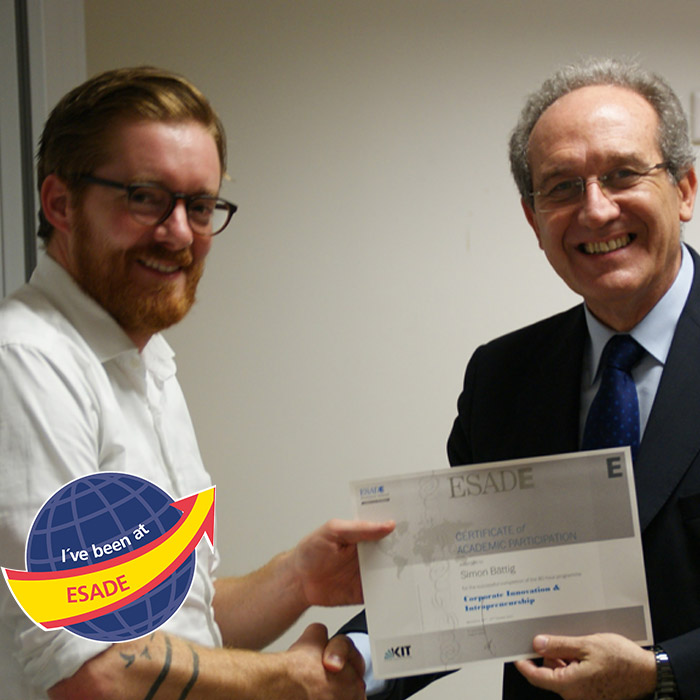
Simon Baettig, Alumnus: "I especially enjoyed the value creation course."
Read more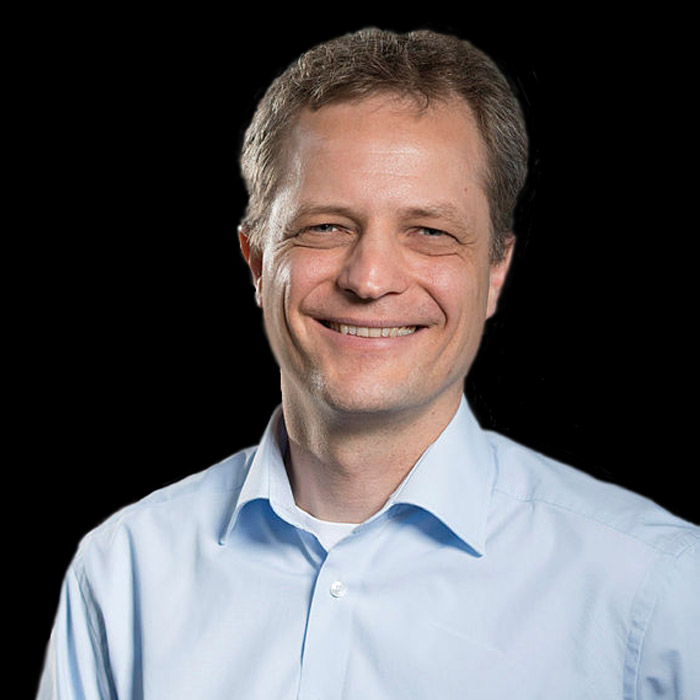
Faces behind HECTOR School:
Program Director Prof. Hiller gives insights.
*Preparatory Course
Crash course "Selected Topics of Electrical Engineering": Participants with few experience in the field of electrical engineering are highly recommended to take part in the crash course, taking place from November 9 - November 13, 2026.
We highly recommend all applicants to participate in the course to update the technical knowledge, as it might be a crucial factor for a successful degree at HECTOR School.
Find out more about our preparatory courses here.