

Carbon Capture and Storage
Certificate Course - Energy Engineering - EE.2.4.I26
| Date | Mar 1 - 2, 2027 | Feb 21 - 22, 2028 |
| Duration | 2 days |
| Location | on campus - Karlsruhe |
| Language | English |
| ECTS | upon request |
| Costs | 1,550 € |
Course Prerequisites - Interest, basic physics and thermodynamics is desirable, but no formal prerequisite.
Fundamentals
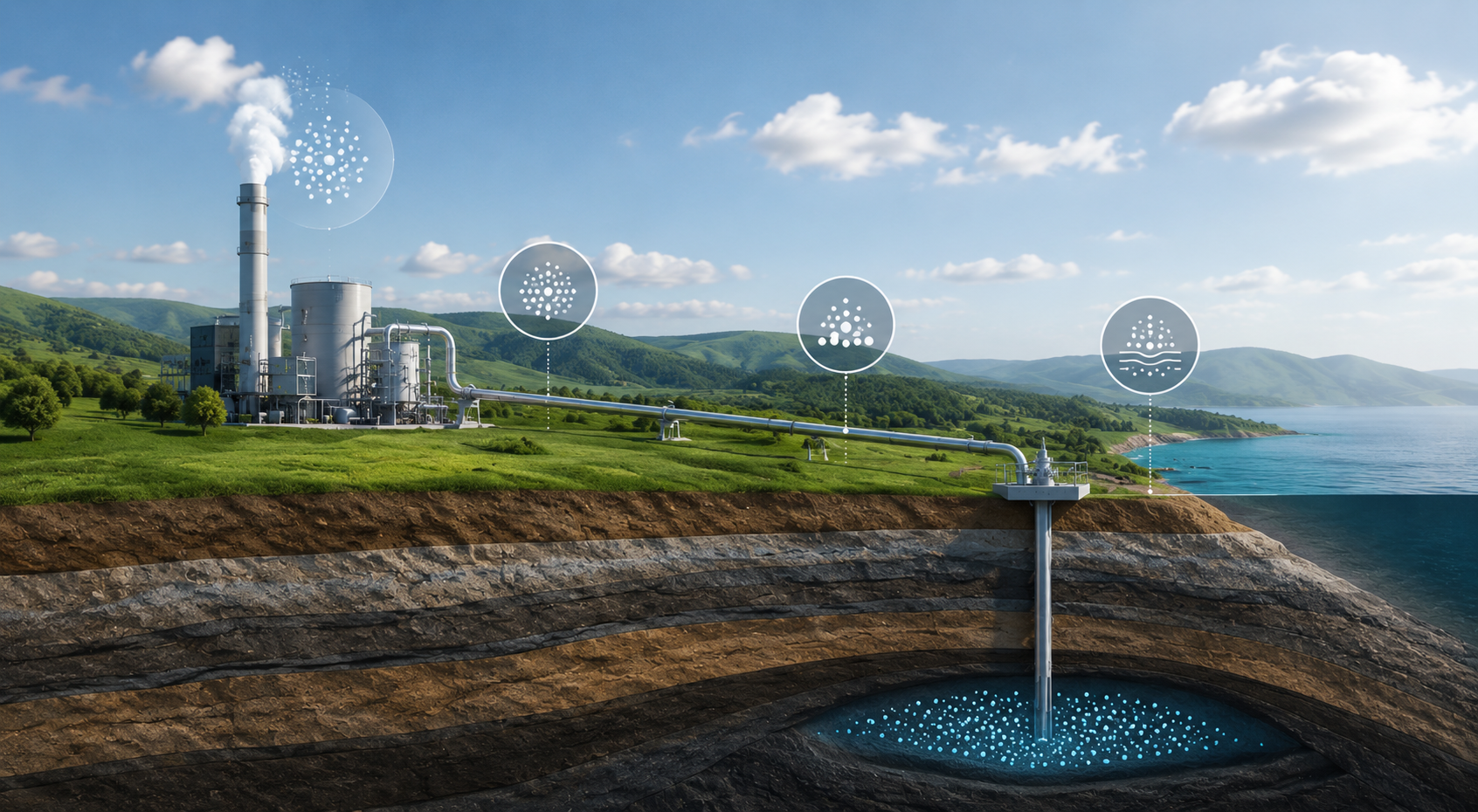
The course aims to build an understanding of the basic principles behind underground gas storage, with a particular focus on carbon capture and storage (CCS). It also explains relevant processes across different length scales, from the nanoscale onward.
Technology
The course covers how these principles are applied in technical systems for underground gas storage and carbon capture and storage technologies.
Applications
It connects these technologies and processes to their broader relevance for addressing climate change.
What You´ll Explore
- Why storing gases underground (Methane, CO2,…).
- Why carbon capture and storage? Global CO2 cycle, anthropogenic CO2 emissions and impact to global and regional climate.
- CO2-capture technologies: Prae-combustion, post-combustion, oxyfuel, chemical looping, further CO2 reduction technologies.
- Gas transport: Required gas quality, materials, transport options.
- Geological gas storage with a special focus on CO2:
- Principles of geological gas storage (caverns, saline aquifers) – the similarities and differences to fluid storage (e.g. oil, waste water) are discussed.
- Enhanced oil recovery; enhanced gas recovery; coal bed methane;
- Trapping mechanisms (special focus on long term safety): Structural trapping; chemical trapping; physical trapping; solubility trapping.
- Exploration & site characterization: Geology, geophysics, geochemical, and geo-mechanical; social aspects.
- Site Development; drilling; monitoring; erection of injection facility.
- Monitoring – Prior – during and after Injection: Physical; chemical; biological.
- Risk assessment – risk management.
Your Key Takeaways
Participants
-
Gain an overview of the basics of bio-geo-chemical processes in the earth system as well as their interaction on the cycle of energy, water, carbon.
-
Are taught the basics of the subject CCS and gains following knowledge and competencies:
-
From nm effects through to climate change; critical disputes with the advantages and risks of gas storage (for energy and CCS);
-
Methods to evaluate and to reduce risks of gas storage – especially CCS;
-
Competencies to scientifically debate the chances and risk of underground gas-storage
-
-
Exercises and case studies add to the understanding of the topic
Taught by Recognized Experts in Carbon Capture and Storage
Benefit from the knowledge of leading specialists with extensive experience in research and industry. Their deep expertise guarantees a course of outstanding academic and practical quality.
Prof. Dr. Frank. Schilling

Prof. Dr. Frank Schilling is Professor of Petrophysics at the Karlsruhe Institute of Technology (KIT) and Director of the State Research Center for Geothermal Energy (LFZG). He studied mineralogy and geology at the University of Tübingen, where he also earned his PhD and later completed his habilitation at the Free University of Berlin. His research focuses on geothermal energy, subsurface utilization, petrophysics, CO₂ storage, and hydrogen storage, with strong emphasis on environmental safety and sustainable energy systems.
Who Should Attend
This certificate course is designed for professionals seeking a comprehensive understanding of photovoltaic technologies and their role in sustainable energy systems.
- Engineers and technical professionals in the energy, electrical, construction, and manufacturing sectors who are involved in the design, implementation, operation, or optimization of photovoltaic systems
- Energy consultants, planners, and project managers working on renewable energy projects, solar installations, and the integration of photovoltaics into existing energy infrastructures
- Professionals in utilities, infrastructure, and public administration who need to evaluate photovoltaic solutions as part of energy transition, sustainability, or decarbonization strategies
- Experts in energy policy, regulation, and financing who require a solid technical and economic understanding of photovoltaic technologies and their market deployment
- Researchers and academics aiming to deepen their knowledge of solar energy conversion, photovoltaic system design, performance analysis, and emerging PV technologies
- Professionals who want a structured overview from the fundamentals of photovoltaics to practical applications, system integration, economic assessment, and the challenges of large-scale solar deployment