

Fuel Cells
Certificate Course - Energy Engineering - EE.2.1.I26
| Date | Feb 22, 2027 | Feb 14, 2028 |
| Duration | 1 day |
| Location | On campus - Karlsruhe |
| Language | English |
| ECTS | Upon request |
| Cost | 990€ |
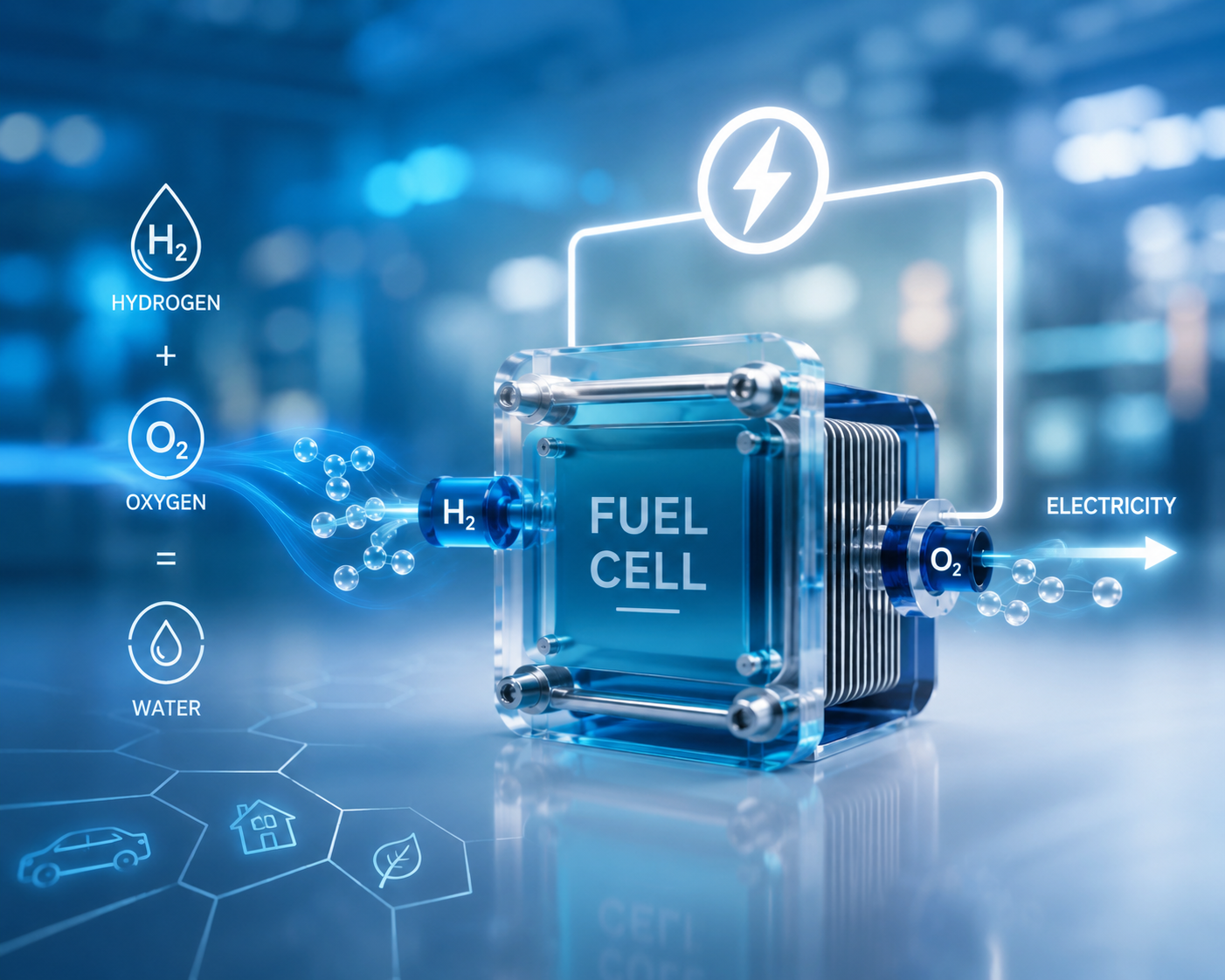
Course Prerequisites - Basic knowledge of chemistry, physics, electrochemistry, and thermodynamics is helpful.
Fundamentals
Understand electrochemical energy conversion, its losses, and the working principles of electrolyzers and fuel cells.
Technology
Compare electrolyzer and fuel cell types, including AEC, PEMEC, SOEC, AFC, PEMFC, MCFC, and SOFC, with principles, advantages, and uses.
Applications
Explain fuel cell applications and compare them with combustion engines and batteries in efficiency, performance, and environmental impact.
What You´ll Explore
- Applications of Fuel Cells
- Comparison with combustion engine and batteries
- Fundamentals of electrochemical energy conversion
- Loss processes in electrochemical energy conversion, activation overpotential, ohmic overpotential, diffusion overpotential
- Working principle of an electrolyzer
- Overview over different electrolyzer types (AEC, PEMEC, SOEC)
- Working principle of a fuel cell
- Overview over different fuel cell types (AFC, PEMFC, MCFC, SOFC)
Your Key Takeaways
- Identify and categorize key applications of fuel cells across various industries, recognizing their potential roles in transportation, stationary power generation, and portable devices.
- Critically compare the performance, efficiency, and environmental impact of fuel cells with combustion engines and batteries, demonstrating an understanding of their respective advantages and limitations.
- Articulate the principles of electrochemical energy conversion, explaining how chemical energy is transformed into electrical energy in fuel cells and electrolyzers.
- Describe the different loss mechanisms in electrochemical energy conversion, including activation overpotential, ohmic overpotential, and diffusion overpotential, and explain how these losses affect the overall efficiency of the systems.
- Explain the fundamental working principle of an electrolyzer, detailing the process of water splitting and the production of hydrogen.
- Differentiate between various electrolyzer types (AEC, PEMEC, SOEC) by describing their specific operational mechanisms, materials used, and typical applications.
- llustrate the working principle of a fuel cell, clearly outlining the electrochemical reactions involved in generating electricity from fuels like hydrogen.
- Distinguish between different types of fuel cells (AFC, PEMFC, MCFC, SOFC) by explaining their unique characteristics, including their operational temperatures, electrolyte materials, and typical uses.
- Apply knowledge of fuel cell and electrolyzer technologies to real-world scenarios, evaluating their potential for integration into current and future energy systems.
Taught by Recognized Experts in Fuel Cells
Benefit from the knowledge of leading specialists with extensive experience in research and industry. Their deep expertise guarantees a course of outstanding academic and practical quality.
Dr. Frieder Scheiba

Dr. Frieder Scheiba is a scientist at the Karlsruhe Institute of Technology, serving as section head at the Institute for Applied Materials (IAM-ESS). His research focuses on carbon-based materials and electrochemical energy storage, including batteries and redox-flow systems. He is involved in multiple large-scale energy projects and has authored numerous publications on electrochemical materials and processes.
Who Should Attend
This certificate course is designed for professionals seeking a structured introduction to fuel cell technologies and their role in sustainable energy and hydrogen-based systems.
- Engineers and technical professionals in the energy, chemical, process, automotive, and manufacturing industries who are involved in or preparing for fuel cell and electrolyzer projects
- Energy consultants, planners, and project managers working on hydrogen strategies, clean mobility solutions, and the evaluation or implementation of fuel cell technologies
- Professionals in utilities, transportation, logistics, and industrial sectors seeking to understand fuel cell applications, system integration, efficiency, and environmental performance
- Experts in energy policy, regulation, and public administration who need a solid technical and economic understanding of fuel cells and electrolyzers to support hydrogen economy initiatives
- Researchers and academics aiming to deepen their knowledge of electrochemical energy conversion, loss mechanisms, fuel cell types, electrolyzer technologies, and their practical applications
- Professionals who want a coherent overview from the fundamentals of fuel cells and electrolyzers to real-world applications, technology comparison, and the assessment of opportunities and challenges in hydrogen-based energy systems