Financial Engineering
Executive Part-Time Master for Professionals

Amid rapid financial innovation, the demand is rising for professionals who can integrate advanced quantitative methods, data-driven modeling, and practical technology skills. The Executive Master in Financial Engineering (FE) prepares you to meet this challenge—arming you with tools to analyze markets, evaluate risk, and engineer financial solutions using Python, AI, and predictive analytics, all grounded in real-world application.
“Financial engineering is the science of making data-driven decisions in business environments. Building more accurate models reduces uncertainty around future events and paves the way for better decision-making.
Our Financial Engineering program is a unique experience, combining broad decision-making applications, sound data and modeling work, and an entrepreneurial drive to solve innovation challenges.”
Prof. Dr. Maxim Ulrich
Program Content
The Master in Financial Engineering offers a unique blend of finance theory, engineering methods, mathematical and computational techniques, and the latest developments in artificial intelligence and data science. The program emphasizes practical application, with hands-on training in Python programming to model markets, analyze risk, and develop innovative financial solutions.
The curriculum also includes five shared management modules with other executive master’s programs. These modules broaden the perspective on business and leadership, strengthen the ability to assess the commercial impact of technical decisions, and provide opportunities for cross-industry networking.
| Engineering Modules (EM) | Management Modules (MM) |
|---|---|
|
|


Global Perspective
- Program taught in English, with a curriculum that provides knowledge for careers in international contexts.
- Learn from an international faculty and peers from 33 countries.

Teaching at the Highest Level
- KIT is one of Germany's leading universities for engineering studies. HECTOR School provides students with KIT's excellent teaching and state-of-the-art research.

Located at a Tech Hotspot
-
Study in Karlsruhe (Germany), a central and dynamic university city that combines technology, culture, and quality of life with excellent conditions for tech professionals.
-
Excellent infrastructure, ideal for personal and professional exploration across Europe.

Structure and Duration
- Participants are enrolled as full-time KIT students, but study part-time with two-week study modules.
- Start in October 2026 (flexible schedule possible) - no application deadline.
- If you need a visa, we recommend applying by June.

Admission Requirements
- Academic degree in a relevant subject, i.e., Engineering, Information Sciences or Economics.
- Min. 2 years professional experience in the specific field.
- English language proficiency.

Program Directors
 |
Prof. Dr. Maxim Ulrich, Institute for Finance, Banking and Insurance (FBV), KIT |
 |
Prof. Dr. Martin E. Ruckes, Institute of Finance, Banking, and Insurance, KIT |
Career Opportunities
Graduates of the Master in Financial Engineering are equipped with a rare combination of advanced technical expertise and comprehensive management skills. This dual qualification opens up career paths that extend beyond traditional quantitative roles, preparing you for both specialist and leadership positions in the global financial industry.
Your deep knowledge of finance theory, data science, machine learning, and Python-based modeling enables you to work as a quantitative analyst, risk manager, portfolio strategist, or financial engineer in banks, investment firms, insurance companies, and FinTech enterprises. At the same time, the integrated management training equips you to understand the broader business and strategic context—qualifying you for positions such as project lead, team manager, or business unit head.
With industries worldwide demanding professionals who can combine technical excellence with business acumen, you will be well positioned to drive innovation in areas such as digital financial markets, AI-driven investment strategies, and data-based corporate finance.
Foto
A door opener (TBC)
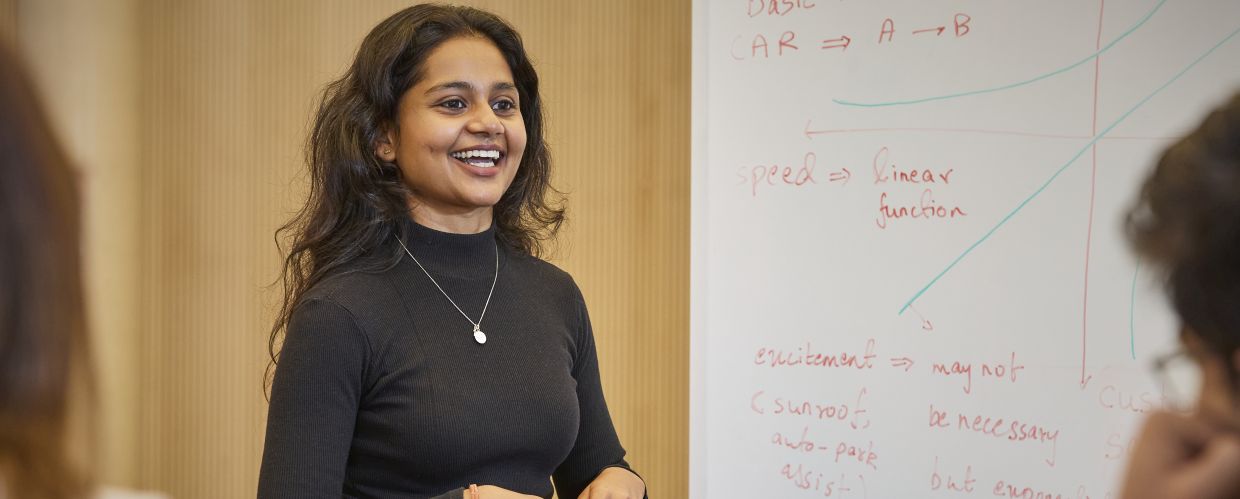
“The Financial Engineering program gave me exactly the tools I needed to advance my career in fintech. The hands-on Python modules and deep dive into financial mathematics prepared me to deliver real value to clients and opened the door to new opportunities. It’s a perfect foundation for anyone aiming to succeed in banking, startups, or even launching their own venture.”
- Vishalini Balakrishnan, graduate of Financial Engineering

The best professors in their fields
"I was very satisfied with the study. The courses are sufficient in terms of content and professors are one of the best in the areas. We could also meet students from totally different cultures backgrounds which made the study much more interesting. It became very important to learn how to cope with multicultural people and now I realized how helpful it was for my job now."
- Emma Liang, graduate of Financial Engineering